Introduction
Running a professional equestrian business is a constant balancing act. Horses need daily care, clients expect personalized service, and trainers must provide high-quality lessons. Amid all these demands lies one task that consumes far more time than many realize: arena maintenance.
Dragging and smoothing riding surfaces is not glamorous work. Yet it is essential – for horse health, rider safety, and professional reputation. But how much time does it really take? And what does this mean for stables struggling with labor shortages and rising costs?
This article breaks down the hidden time investment of arena grooming, calculates the long-term costs, and explores how automation can free up hundreds of hours per year.
The Frequency of Arena Maintenance
The ideal grooming frequency depends on usage, but experts and veterinarians recommend:
- Light daily use: at least once per day.
- Heavy daily use (e.g. riding schools, training centers): 3–5 times per day.
- Event preparation: additional grooming between classes or rounds.
This means that in busy professional stables, arena dragging is not an occasional chore – it is a repetitive routine task that dominates the daily schedule.
The Time Factor: A Real Calculation
Let’s break down the numbers:
- Average time to drag an arena: 30 minutes
- Grooming frequency in a training facility: 3 times per day
- Total daily time: 1.5 hours
- Over a week: 10.5 hours
- Over a month: ~45 hours
- Over a year: ~550 hours
That’s the equivalent of 70 full working days – spent only on arena grooming.
Now imagine this multiplied across multiple arenas in a large facility. The numbers quickly become staggering.
The True Cost of Manual Grooming
Time is not the only factor. Manual arena grooming also means:
- Labor costs: Skilled staff spend time on routine work instead of training or horse care.
- Equipment costs: Tractors are expensive to purchase, fuel, and maintain.
- Opportunity costs: Every half-hour spent grooming is a half-hour not spent with clients.
In the competitive equestrian market, these opportunity costs can have a direct impact on customer satisfaction and revenue.
Inconsistency: A Hidden Risk
Another often-overlooked aspect is inconsistency.
- Staff members groom differently.
- Fatigue can lead to shortcuts.
- Missed grooming sessions can quickly degrade surfaces.
The result is uneven footing, which increases the risk of injuries and shortens the lifespan of arena surfaces – leading to expensive renovations.
Automation as a Time-Saver
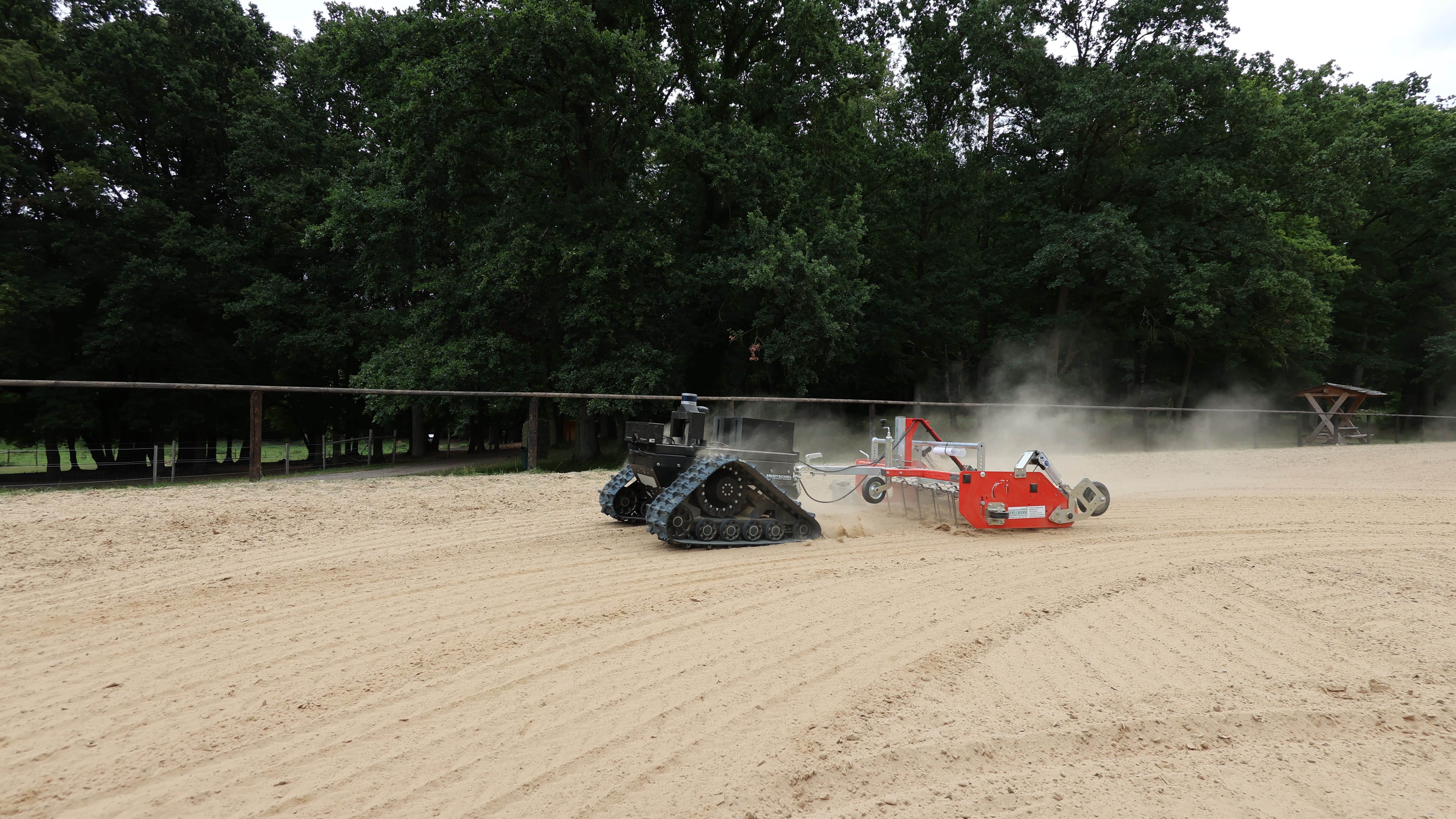
This is where autonomous arena maintenance robots change the equation:
- They run predefined routes without supervision.
- They work quietly, even outside normal hours.
- They deliver consistent, repeatable results every time.
By taking over a task that consumes hundreds of hours annually, automation frees staff to focus on core value-creating activities: horse training, lessons, and client service.
The Business Perspective: ROI in Time and Money
Let’s return to the earlier calculation: 550 hours per year.
- If staff costs are €20/hour, that’s €11,000 per year spent on arena grooming.
- Add fuel, tractor wear, and maintenance – the total is significantly higher.
An autonomous arena robot, with its low energy consumption and minimal maintenance, can pay for itself quickly by reducing labor and equipment costs. More importantly, it transforms wasted time into productive time.
Beyond Numbers: Quality of Life and Reputation
There is also a human factor. Staff members often find arena dragging monotonous and demotivating. Automating this task improves job satisfaction by letting them focus on more rewarding work.
For clients, consistently well-maintained arenas send a strong signal: this is a professional stable that invests in quality. A small detail – but in premium equestrian businesses, details make the difference.
Conclusion
Arena maintenance is not just a side task. It is a massive time sink that eats into staff hours, budgets, and client satisfaction. By automating this routine, professional stables can save hundreds of hours annually, reduce costs, improve horse health, and strengthen their reputation.
The real question is no longer “How much time does arena maintenance take?” – we know the answer: too much. The real question is: How long can you afford not to automate it?